How to Quote a Lawn Job in Under 60 Seconds (and Actually Win It)
A faster, more professional way to price lawn care jobs — measure the property, build an itemized quote, and send it before your competitor calls back.

The job goes to whoever quotes first — not whoever quotes lowest. When a homeowner reaches out to three lawn care pros, the one who answers with a clear, itemized price usually wins before the others have stopped their mower to call back.
The problem is that "fast" and "professional" usually pull in opposite directions. Scribble a number on a notepad and you look like a guess. Build a real estimate and it eats your evening. Here's how to do both at once.
Why does the first quote usually win?
Hiring a stranger to work on your property is uncomfortable. The homeowner isn't really shopping for the lowest price — they're shopping for the least risky decision. The first pro who replies with something specific ("$45 per visit, weekly, includes mow, edge, and blow") feels like the safe choice. Vague replies that arrive a day later feel like a hassle, even if the number is lower.
So the goal isn't to be cheap. It's to be fast, specific, and clearly professional — in that order.
Step 1: Measure the property before you price it
Eyeballing lot size from the street is how you end up either underbidding a job that takes twice as long as you thought, or scaring off a customer with a padded "just in case" number.
In Lawnzie, you pull the property up on a map, get the measured lot size, and price from there. When your number is anchored to an actual square footage instead of a gut feel, two things happen: your margins stop leaking on big yards, and you can confidently explain why the price is what it is.
Price the lawn, not the lot
Most of a residential lot isn't turf — it's house, driveway, beds, and hardscape. Quote off the area you'll actually service, not the full parcel, and you'll be both more accurate and more competitive.
Step 2: Build an itemized quote, not a single number
A lump sum invites haggling. An itemized quote invites a yes. When the homeowner can see the line items, the price stops feeling arbitrary:
- Mow — by square footage, flat rate, or per visit
- Edge & trim — flat add-on
- Blow / cleanup — flat add-on
- Extras — leaf cleanup, bed weeding, hedge trimming, priced per unit
Lawnzie supports per-square-foot, flat, and per-unit pricing in the same quote, so you can mix and match instead of forcing every job into one model. Itemizing also makes upsells painless — the customer can literally see the "add bed weeding for $20" line and check the box.
Step 3: Save it as a template so next time takes 10 seconds
Most lawn care businesses really only sell three or four job types over and over: the weekly residential mow, the biweekly mow, the one-time cleanup, the recurring full-service package. Build each one once as a quote template. After that, a new quote is: open the template, adjust for this property's size, send.
That's the whole trick behind "60 seconds." You're not building a quote from scratch every time — you're personalizing one you already perfected.
Step 4: Send something that looks like a business sent it
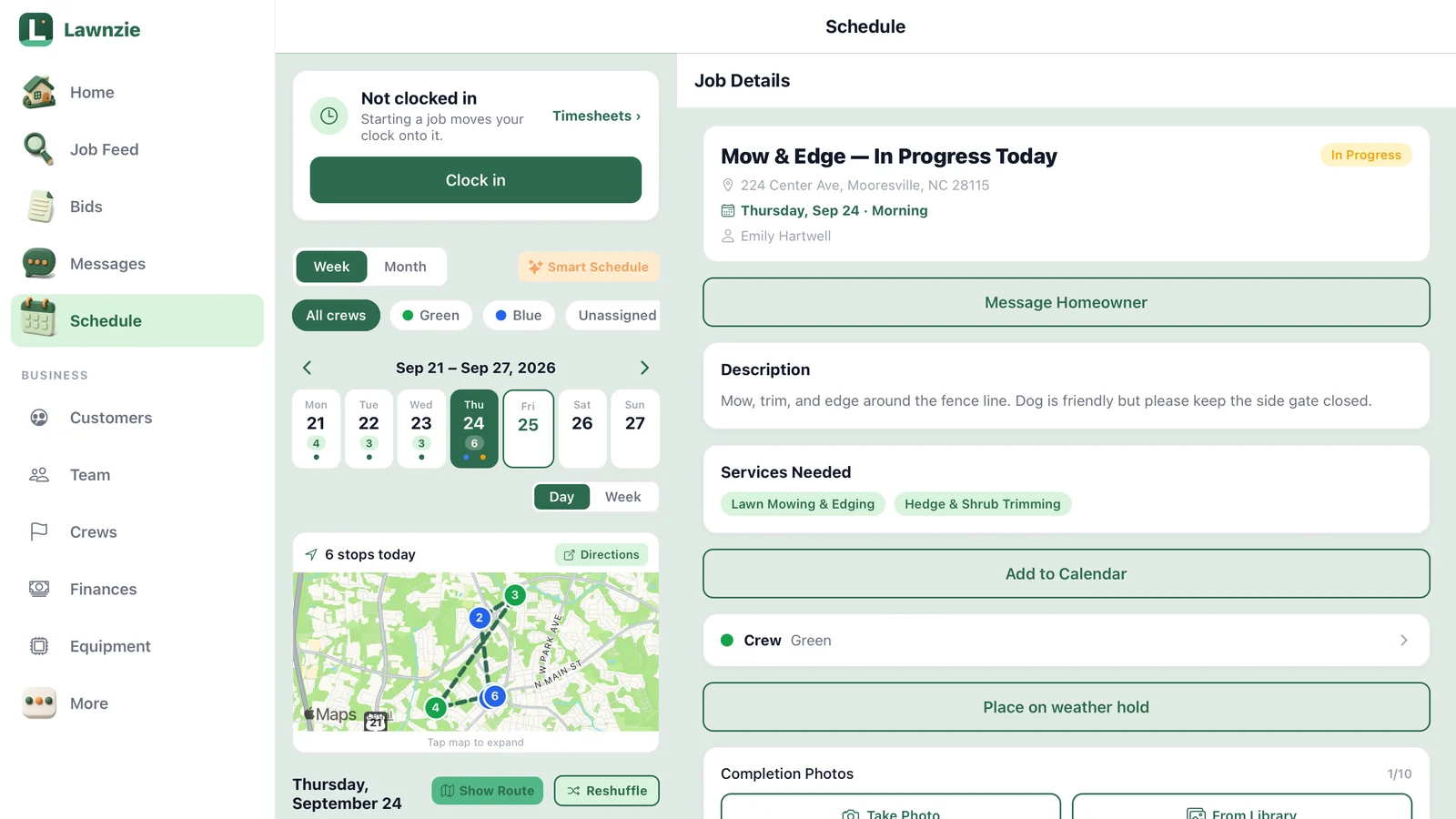
A quote with your business name on it does quiet work. It tells the homeowner you're insured-minded, organized, and around to stay. When you close the job, Lawnzie turns the same line items into a branded PDF invoice — no retyping, no separate invoicing app, and a paper trail that makes you look like the professional you are.
And because the conversation lives in in-app messaging, you can answer the "can you also do the hedges?" follow-up and update the quote without losing the thread in a pile of texts.
Step 5: Follow up without being annoying
A quote sent is not a quote accepted. A single, friendly nudge a day later — "Hey, just making sure you got the quote, happy to adjust anything" — recovers more jobs than most pros realize. Keep the conversation in one place so you actually remember to do it.
The math on speed
If quoting faster lets you send even a few more estimates a week, and you close a healthy share of them, that's real recurring revenue — without spending a dollar more on marketing. Speed is the cheapest growth lever you have.
The 60-second quote, start to finish
- Open the property and grab the measured lot size.
- Load your template for this job type.
- Adjust the line items for this yard.
- Send the itemized quote in your business's name.
- Nudge once the next day if you don't hear back.
Do that consistently and you stop competing on price. You start competing on professionalism — which is a game you can actually win.
Ready to stop quoting from a notepad? See everything Lawnzie gives lawn care pros on the For Contractors page.
Frequently asked questions
How do I price a lawn I haven't seen in person?+
Pull the property up on a map to get the measured lot size, price your service per square foot, and send an itemized quote. You can always add a line for anything unexpected once you're on site — but a measured, itemized estimate is far more accurate than guessing from the street.
Should I charge per square foot, flat rate, or per visit?+
Use whichever fits the job. Flat or per-visit pricing works well for predictable residential mows; per-square-foot keeps you honest on large or unusual lots; per-unit is great for add-ons like hedges or cleanup. Lawnzie lets you combine all three in a single quote.
Is it better to quote low to win the job?+
Usually not. Homeowners hire the pro who feels the safest, not the cheapest. A fast, clear, itemized quote in your business's name beats a lower number that looks like a guess. Compete on professionalism, not price.
How do I turn an accepted quote into an invoice?+
In Lawnzie, the quote's line items carry straight into a branded PDF invoice when the job is done — no retyping. Homeowners pay securely and the full quoted amount goes to your bank account.